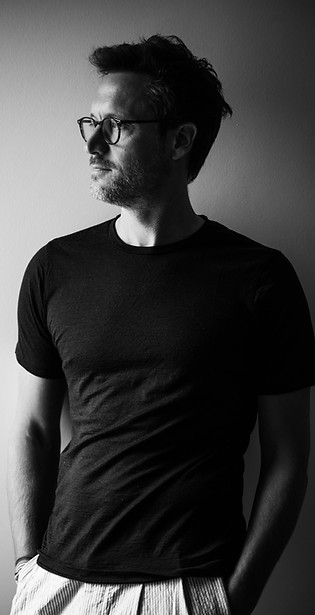
I trained as a designer. I studied industrial design at the École Nationale Supérieure des Arts Appliqués et des Métiers d’Art (ENSAAMA) in Paris, then at the Royal College of Art (RCA) in London. Initially drawn to form and style, I soon became interested in use and sociology, and then in the strategic and economic side of it all.
In London, my tutors were Anthony Dunne, founder of the critical design movement, and Durrell Bishop, a forerunner of tangible interfaces (interacting with the digital world through physical artefacts). In the early 2000s, objects were changing: they were no longer conceived as isolated products, but as connected, ‘smart’ systems, each a gateway to a service.
This meant rethinking how such systems are designed and inventing new methods. An interaction or a service cannot be imagined on paper: you have to live it and experience it in order to create it. Questioning existing tools so as not to be confined by them has stayed with me ever since. It was this that led, a few years later, to the Interaction Lab.
I began my career at IDEO in Palo Alto, in the Smart Products department. There I crossed paths with Bill Moggridge, who gave interaction design its name, and Naoto Fukasawa, whose pared-back aesthetic, born of everyday gestures, has had a lasting influence on me.
I then joined INRIA, the French National Institute for Research in Digital Science and Technology, in the human–computer interaction (HCI) group led by Wendy Mackay and Michel Beaudouin-Lafon. Our work led to scientific publications and patents.
At Renault’s design direction, I helped set up the advanced HMI team within the Prospective & Concept Cars studio. I also learnt how a large group works, from development processes to the human and political dynamics of decision-making.
In 2007, I founded id-sl, and Renault became my first client. Since then, I have worked mainly with large French corporations, across a wide range of sectors. My first clients were R&D departments, on technology and interfaces. Because I approached projects as a whole, strategic marketing followed: building 360° visions, defining new offers and experiences, and embodying them at every touchpoint. Then came innovation and design departments, to support their teams, put methods in place and help them gain visibility with other departments and the executive committee.
I teach regularly at design, engineering and business schools. Most notably, I taught for ten years at École Polytechnique, in the Department of Humanities and Social Sciences, as well as at the École nationale supérieure des Arts Décoratifs de Paris (EnsAD) and at École des Ponts, on the entrepreneurship programme and ME310, run with Stanford. I have published several scientific papers with innovation management researchers on the role of making in thinking and decision-making. I also give talks in France and abroad.
Publications, patents and talks (PDF) →